
Sealed Once, Filled Daily: The Holy Spirit and Sanctification
Sealed Once, Filled Daily: The Holy Spirit and Sanctification
Sometimes the truths that change us most fit on a single whiteboard.
On Saturday, October 31, 2026, at the Alpha Day Away, Pastor Pablo taught on the Holy Spirit’s work in a believer’s life. A stick figure in a box, a few arrows, and a handful of words that opened up a lot of Scripture.
Huge thanks to Pastor Pablo for the teaching and to the Alpha team for the day. These are my notes, tidied up and checked against the Bible (NIV quoted throughout).
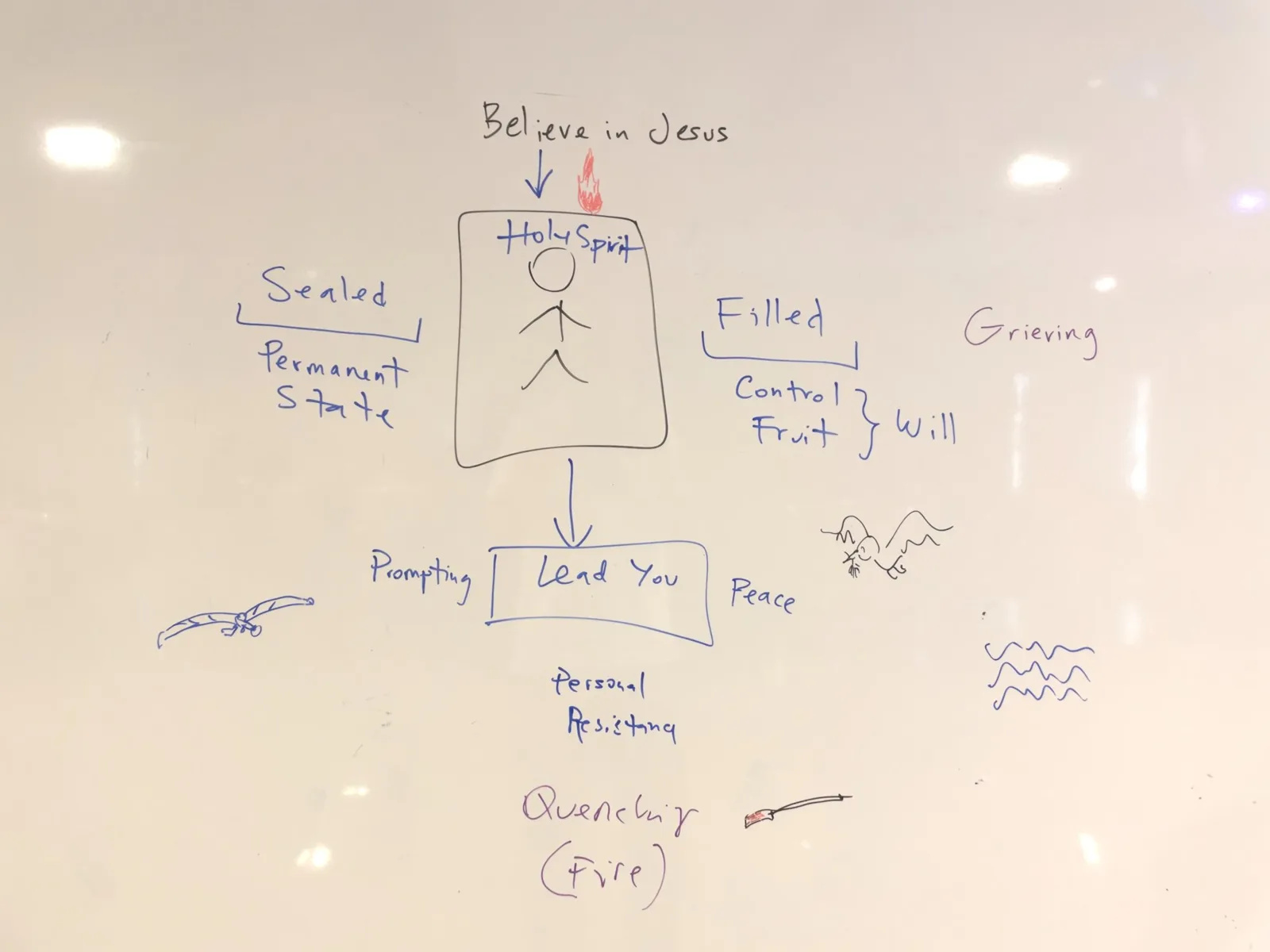
The Starting Point: Believe in Jesus
The top of the board says it simply: Believe in Jesus, with an arrow pointing down into the box. When you put your trust in Jesus, the Holy Spirit comes in. Not as a visitor passing through, but to stay.
From there, the board branches into four ideas: sealed, filled, led, and two warnings, grieving and quenching.
Sealed: A Permanent State
On the left of the board: Sealed. Permanent state.
“And you also were included in Christ when you heard the message of truth, the gospel of your salvation. When you believed, you were marked in him with a seal, the promised Holy Spirit, who is a deposit guaranteeing our inheritance until the redemption of those who are God’s possession—to the praise of his glory.” (Ephesians 1:13-14)
A seal in the ancient world marked ownership and authenticity. Paul says the Spirit Himself is that seal, and a deposit, a down payment guaranteeing the rest. This happens once, when we believe. It isn’t something we earn, and it isn’t something that wears off on a bad week.
In theology terms this is positional. It’s who you are in Christ.
Filled: Control, Fruit, and Our Will
On the right of the board: Filled, with Control and Fruit bracketed together next to the word Will.
“Do not get drunk on wine, which leads to debauchery. Instead, be filled with the Spirit,” (Ephesians 5:18)
Paul’s contrast is deliberate. Wine takes control of a person. The Spirit should be the one in control instead. And when He is, the result is fruit:
“But the fruit of the Spirit is love, joy, peace, forbearance, kindness, goodness, faithfulness, gentleness and self-control. Against such things there is no law.” (Galatians 5:22-23)
Here’s the key difference from being sealed: being filled involves our will. Sealing is done once. Filling is an ongoing yielding, a daily “You lead, I’ll follow.” Notice it’s fruit, singular, not a menu where I pick joy and skip self-control.
Led: Promptings and Peace
In the middle, under the box: Lead You, with Prompting on one side and Peace on the other, and below it, Personal and Resisting.
“For those who are led by the Spirit of God are the children of God.” (Romans 8:14)
“Let the peace of Christ rule in your hearts, since as members of one body you were called to peace. And be thankful.” (Colossians 3:15)
The Spirit leads personally: a nudge to call someone, a check in your spirit before you say something, a settled peace (or a lack of it) about a decision. The Greek word behind “rule” in Colossians 3:15 carries the idea of an umpire. Peace gets to make the call.
But we can say no. Stephen’s words to the council are sobering:
“You stiff-necked people! Your hearts and ears are still uncircumcised. You are just like your ancestors: You always resist the Holy Spirit!” (Acts 7:51)
Being led is relational. He prompts; we respond, or we don’t.
Two Warnings: Don’t Grieve, Don’t Quench
On the right edge, in purple: Grieving. Near the bottom: Quenching (Fire).
“And do not grieve the Holy Spirit of God, with whom you were sealed for the day of redemption.” (Ephesians 4:30)
The context matters, so here are the verses either side:
“Do not let any unwholesome talk come out of your mouths, but only what is helpful for building others up according to their needs, that it may benefit those who listen. … Get rid of all bitterness, rage and anger, brawling and slander, along with every form of malice. Be kind and compassionate to one another, forgiving each other, just as in Christ God forgave you.” (Ephesians 4:29, 31-32)
Two things jump out. First, the Spirit is a Person. You can’t grieve a force or an energy; you grieve someone who loves you. Second, what grieves Him here is mostly about how we treat each other: bitterness, anger, harsh words. Notice too that even in the warning, Paul reminds us we’re still sealed. Grieving Him doesn’t undo the seal. It hurts the relationship.
And the second warning is just five words:
“Do not quench the Spirit.” (1 Thessalonians 5:19)
Quenching is what you do to a fire. You pour water on it. Grieving is about sin that hurts Him; quenching is about stifling what He wants to do. Ignoring the prompting. Talking yourself out of the kind word. Pouring cold water on the flame.
The Pictures: Fire, Dove, Wind, Water
Later, Uncle Steven expanded on what Pastor Pablo drew, adding the fire, dove, wind and water, each a biblical picture of the Spirit, and explaining what each one means:
- Fire (the red flame): “They saw what seemed to be tongues of fire that separated and came to rest on each of them.” (Acts 2:3)
- Dove: “and the Holy Spirit descended on him in bodily form like a dove.” (Luke 3:22)
- Wind (drawn on the left of the board as a glider): “The wind blows wherever it pleases. You hear its sound, but you cannot tell where it comes from or where it is going. So it is with everyone born of the Spirit.” (John 3:8), and at Pentecost, “a sound like the blowing of a violent wind came from heaven” (Acts 2:2)
- Water: “Whoever believes in me, as Scripture has said, rivers of living water will flow from within them.” By this he meant the Spirit (John 7:38-39)
- Forge and quench (one more of Uncle Steven’s drawings, below the others): a shovel-like tool for working metal. You put the metal in the fire to forge it, then plunge it into water to stop the forging. It ties to Quenching on the board: “Do not quench the Spirit.” (1 Thessalonians 5:19)
Fire purifies and warms. A dove is gentle. Wind is powerful and you can’t control it. Water gives life and keeps flowing. No single picture captures Him, which is kind of the point.
Unseen, but Real
We can’t see the Holy Spirit, just as we can’t see the wind. The Bible’s own words make the link. In Hebrew, ruach (רוּחַ) means spirit, wind and breath, all in one word. It’s the ruach of God hovering over the waters in Genesis 1:2. In Greek, pneuma (πνεῦμα) works the same way, and in John 3:8 Jesus uses it both ways in a single sentence: the wind (pneuma) blows wherever it pleases, and so it is with everyone born of the Spirit (pneuma). Jesus says this to Nicodemus while explaining the new birth: “no one can see the kingdom of God unless they are born again” (John 3:3), and “You must be born again” (John 3:7). Being born again is like the wind. It’s the Spirit’s unseen work, but you see it in a changed life.
You can’t see the wind, but you can feel it on your face, watch the trees bend, and hear it rattle the windows. That’s why the glider on the board is such a good picture. A glider has no engine. It rises only on air it can’t see, and the pilot’s job isn’t to flap harder but to find the lift and stay in it. The Spirit is like that. Unseen, yet real enough to lift a life that could never get off the ground on its own.
A Few Things That Made Me Smile
- How simple it was. A few words and a stick figure carried truths the church has treasured for two thousand years. God doesn’t need complicated to change a life.
- “Quenching.” Anyone who has ever ignored a gentle nudge to apologise first knows exactly how good we can be at playing fire extinguisher.
- The prayer at the end: “Holy Spirit, fill me and lead me today.” Eight words. Even I can remember it before breakfast.
Where Sanctification Fits
This is where the whiteboard clicked for me. Sanctification is the ongoing work of God’s Spirit by which believers are progressively made holy, becoming more like Jesus. It sits between justification (declared righteous, once for all) and glorification (made perfect, one day).
The board maps onto that neatly:
| Whiteboard | When | Sanctification |
|---|---|---|
| Sealed | Once, when we believe | Positional: set apart, belonging to God |
| Filled | Daily, involves our will | Progressive: the Spirit producing fruit |
| Led | Moment by moment | Practical: following His promptings and peace |
| Grieving / Quenching | Whenever we resist | What stalls the growth |
Paul holds both sides together in one breath:
“continue to work out your salvation with fear and trembling, for it is God who works in you to will and to act in order to fulfill his good purpose.” (Philippians 2:12-13)
We work it out; He works it in. Being sealed is the security that makes the growing safe. We don’t grow in holiness to get sealed. We grow because we already are, and because He doesn’t quit:
“being confident of this, that he who began a good work in you will carry it on to completion until the day of Christ Jesus.” (Philippians 1:6)
Practical Takeaways
- Start the day with a simple prayer: “Holy Spirit, fill me and lead me today.” Short enough to pray before your feet hit the floor.
- Rest in the seal. On the bad days, remember it’s a permanent state. You don’t have to earn it again.
- Yield on purpose. Filling involves the will. Ask, “Where am I keeping the controls today?”
- Pay attention to promptings and peace. If a quiet nudge lines up with Scripture, act on it rather than debating it into silence.
- Watch your words. Ephesians 4:29-32 makes it clear that bitterness and harsh talk grieve Him. Kindness and forgiveness are the opposite.
- Don’t pour water on the fire. When you sense Him moving, lean in.
- Expect fruit, slowly. Sanctification is progress, not perfection. Look back a year from now and thank God for what’s grown.
Sign-off
One whiteboard, one stick figure, a lot of Scripture. Sealed once. Filled daily. Led personally. And the whole thing driven not by our effort alone but by a Person who lives in us and is committed to finishing what He started.
Thank You, Lord, first of all, for the Spirit You’ve given us and for our Alpha Day Away, a whole day spent learning about Him. And thank you to Pastor Pablo for the teaching, to Uncle Steven for the drawings and for explaining them, and to the whole Alpha team for all your care. If you’ve never done Alpha, I’d genuinely recommend it. Good food, honest questions, and a warm welcome, whatever you believe right now.
Holy Spirit, fill me and lead me today.
P.S. This whole board started with an anonymous question I scribbled for the group: “How to be filled with the Holy Spirit all day?” Pastor Pablo began answering it with a marker, and it opened up questions and conversations for others too. I’m grateful the Holy Spirit gave me that question to ask.
// RELATED_ARCHIVES

> Jun 2026 · 6 min read
Escaping the Pride Trap of Social Anxiety
How pride fuels the exhausting cycle of social anxiety and the path to freedom through humility in Christ.

> Nov 2025 · 7 min read
When Science and Faith Team Up
Have you ever looked at the stars and wondered if someone's behind it all? Let's see how science and faith actually work together, not fight.